


Creating positive changes for patients
USask alumni Jeff Costley (AGRIC’00) and Dr. Kara Schick-Makaroff (BSN’99, PhD) are part of a group exploring the mental health impacts of kidney dialysis and developing helpful person-centred resources
By SHANNON BOKLASCHUKTwo University of Saskatchewan (USask) graduates are working together to raise awareness of the mental health impacts of kidney dialysis, with the goal of improving care for patients in Canada and around the world.
USask alumni Jeff Costley (AGRIC’00) and Dr. Kara Schick-Makaroff (BSN’99, PhD), who live in Alberta, are part of a community advisory committee in that province. The committee members—who share a vision of living well with kidney disease—include researchers, caregivers, health-care professionals and trainees, and patients like Costley, who bring their lived experiences to the group.
“I would like to see a change in how mental health issues are addressed in the dialysis setting,” said Costley, who lives in Lethbridge, Alta., and has been a dialysis patient for 16 years. “There has to be a shift in the dynamic from ‘it’s not part of my job’ to everyone’s responsibility.”
Both Costley and Schick-Makaroff are originally from Saskatchewan and studied at USask. Costley earned a diploma at USask’s College of Agriculture and Bioresources in 2000, while Schick-Makaroff earned a Bachelor of Science in Nursing degree at USask’s College of Nursing in 1999. Today, Schick-Makaroff is a professor of nursing and associate dean of graduate studies in the Faculty of Nursing at the University of Alberta (U of A) in Edmonton, Alta., where her research program aims to enhance knowledge about the use of quality of life assessment and promote equitable person-centred health, in order to improve services for people living at home with chronic and life-limiting illnesses, particularly kidney failure.
Schick-Makaroff noted that, traditionally, emotional wellbeing has been an overlooked part of dialysis treatment and there has also been social stigma around mental health issues. Through collaborative patient-oriented research, Schick-Makaroff, Costley, and the community advisory committee are working to address that.
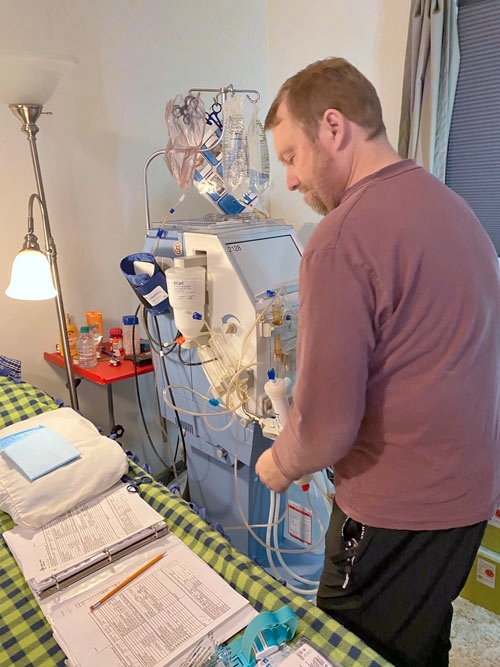
“I would like to see a change in how mental health issues are addressed in the dialysis setting,” said Jeff Costley, who has been a dialysis patient for 16 years.
“Research ideas are often generated from people with lived experience,” Schick-Makaroff said. “From inception through to dissemination, those most impacted are collaborating and co-leading the innovations.”
Costley first became ill in 2009. In 2010, he received a kidney from his brother, but the transplant soon failed—something that was very disappointing and took a significant emotional toll on Costley. He has also had to adapt to many changes in his life due to his kidney condition, including receiving dialysis in hospital four times a week, permanent disability leave, and numerous side effects, such as brain fog, from the treatments. Costley said these types of experiences can be overwhelming for dialysis patients.
“The change in lifestyle is quite drastic. Diet restrictions and fluid restrictions, lack of energy, and the inability to concentrate all take time to get accustomed to,” he said.
“Secondly, the feeling of isolation and questions like ‘why me?’ are things that I went through.”
After taking part in group therapy and seeking support from a variety of health-care professionals, Costley met a psychiatrist who helped him work through his emotions. Costley continues to do nocturnal hemodialysis at home four nights a week and has found the mental health support that he needs in his psychiatrist.
“You never know when you’re going to have a bad day—and, so, it’s always good to have that support,” he said.
According to Alberta Health Services, nearly one in three Albertans receiving dialysis treatment will experience symptoms that may look like depression and one in five for anxiety. Costley is motivated to share his health-care journey with others because he doesn’t want dialysis patients to feel alone. In 2016, he joined the community advisory committee on the advice of a friend, and for the last decade he has shared his lived experiences to help other patients.

The person-centred work at the U of A is co-led by patients like Costley, along with kidney care providers, university students, health-care trainees, and others. The community advisory committee recently created a list of freely available mental health resources for dialysis patients in every province and territory in Canada, and is currently evaluating how well cognitive behavioural therapy (CBT) works for people receiving dialysis. The committee has also launched Your Journey: Coping With and Adjusting to Dialysis, an online patient-facing pathway for mental health care. The resource—which was designed by patients for use by patients—avoids stigmatizing words and potentially confusing clinical terminology.
“The emotional challenges of living with dialysis are hugely unaddressed internationally, not just in Canada. And the work that we are doing to create this roadmap—we call it a pathway—is the first that's ever been created anywhere in the world for people receiving dialysis,” said Schick-Makaroff, who serves as co-lead of Mind the Gap, a national research project within the Can-SOLVE CKD Network.
“It kind of bridges aspects of health care, because traditionally we're very siloed,” she added. “So, you go here for dialysis and here for cardiac and here for neurology and here for mental health. One of the things that we’re just really aware of is that a person is multi-dimensional. So, while you go to dialysis for care of your kidneys, lots and lots and lots of other things are impacted. We’re not saying that the emotional wellbeing is the most important, but it’s one part that hasn’t been addressed so far. One of the key findings are to acknowledge, for many people, this (kidney dialysis) is a really big challenge.”
Schick-Makaroff said the resources that the community advisory committee members have created are now available for use, free of charge, by patients, clinicians, and others in every province and territory in Canada. Both Schick-Makaroff and Costley want to continue to change how care for patients receiving dialysis treatment is talked about and understood in the health-care system.
“The best part of the committee is the ability to give something back and hopefully make changes for the better,” Costley said.
Together, we will undertake the research the world needs. We invite you to join by supporting critical research at USask.