

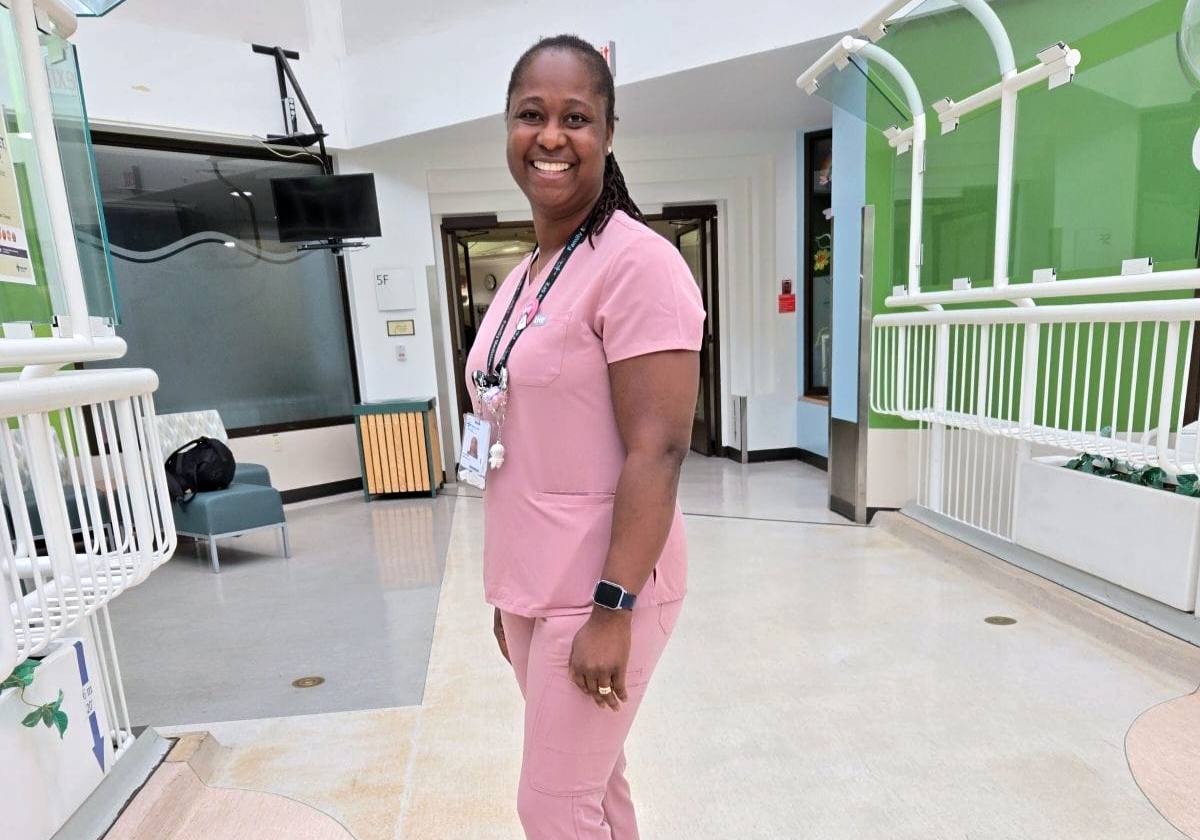
Take 5: Five facts about working as a registered nurse in family medicine
Augustina Adekoya has found her place as a registered nurse, while advancing her nursing education in the Master of Nursing Professional Practice Program.
Becoming a registered nurse (RN) opens the door to many fields within the profession, but for Master of Nursing Professional Practice student Augustina Adekoya working in family medicine as a registered nurse and charge nurse is her place. While continuing to work as an RN, she is studying in the College of Nursing to complete her Master of Nursing.
We asked Adekoya what five things people should know about working as an RN in family medicine.
1. Building meaningful relationships with patients.
Family medicine appealed to Adekoya because it gives her the opportunity to build long-term relationships with patients and support them throughout their healthcare journey. She finds particular fulfillment in caring for older adults, whose complex health needs often benefit from consistent, compassionate, team-based care.
“Caring for the elderly feels like a privilege,” said Adekoya. “Many of them have rich life stories, and I enjoy being part of a care team that supports them not just medically, but holistically.”
2. No day is ever the same.
Each day brings her a new set of tasks as she cares for different patients and takes on the role of being a RN on the floor or the charge nurse.
“On days when I am a registered nurse, my day usually involves patient assessments, medication administration, behaviour mapping, chronic disease management, and lots of patient and family education.”
The days when she is the charge nurse comes with additional responsibilities, but she enjoys every minute of it.
3. Listening is the most important task.
Adekoya says her daily work spans everything from basic health assessments and assisting with wound care to medication administration and health education. But one of the most important parts of her job? Listening. “A big part of my role is listening, understanding patients' concerns and advocating for them.”
4. Being a charge nurse in family medicine provides variety (and additional responsibility).
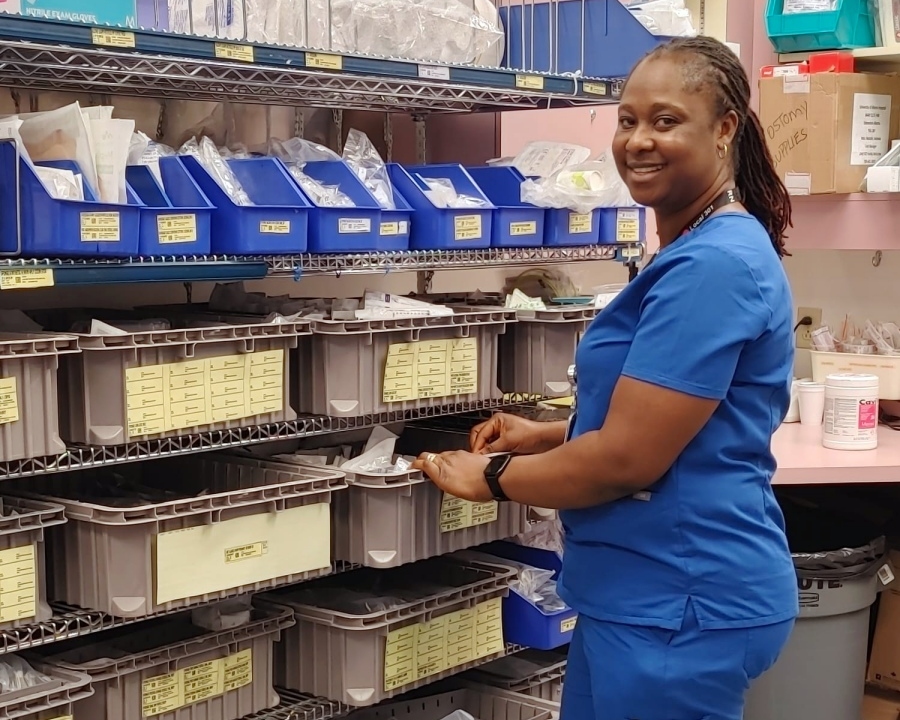
RN Augustina Adekoya in the family medicine supply room. Credit: Submitted.
Collaboration and coordination are central to Adekoya's role as charge nurse, as she works with healthcare teams to support patients throughout their care journey.
“As a charge nurse, I am expected to know where the patients came from, the plan of care, and the discharge disposition,” said Adekoya. “I coordinate interdisciplinary rounds, update the floor staff, and work closely with physicians and other healthcare professionals to coordinate care and ensure patients' needs are met in the hospital and in the community after discharge.”
RN Augustina Adekoya in the family medicine supply room. Credit: Submitted.
Collaboration and coordination are central to Adekoya's role as charge nurse, as she works with healthcare teams to support patients throughout their care journey.
“As a charge nurse, I am expected to know where the patients came from, the plan of care, and the discharge disposition,” said Adekoya. “I coordinate interdisciplinary rounds, update the floor staff, and work closely with physicians and other healthcare professionals to coordinate care and ensure patients' needs are met in the hospital and in the community after discharge.”
5. Stay curious.
Adekoya’s advice to those considering a nursing career in family medicine is to stay curious and open-minded. Nursing is vast.
“If you enjoy building long-term relationships, thinking critically, and making a real difference in older adults' health, and most importantly, during end of life, this area of nursing is for you.”